
Moulded thermoplastic materials: performance and versatility
The quality of a plastic component starts with the quality of the raw material. For this reason, at ETI Srl we provide contract moulding of certified and traceable thermoplastic materials, capable of meeting even the most complex technical requirements.
We process a wide range of materials, from the most commonly used ones such as PP (Polypropylene), PS (Polystyrene) and PE (Polyethylene), through to high-performance engineering polymers such as ABS (Acrylonitrile Butadiene Styrene), PC (Polycarbonate) and PA (Polyamide). Each polymer is selected to ensure specific performance characteristics: elasticity, heat resistance, stiffness or compatibility with food industry applications.
Are you looking for support in selecting the right material for your project? Contact us: we will help you identify the most suitable solution for your sector and production cycle.
Selected suppliers and quality controls
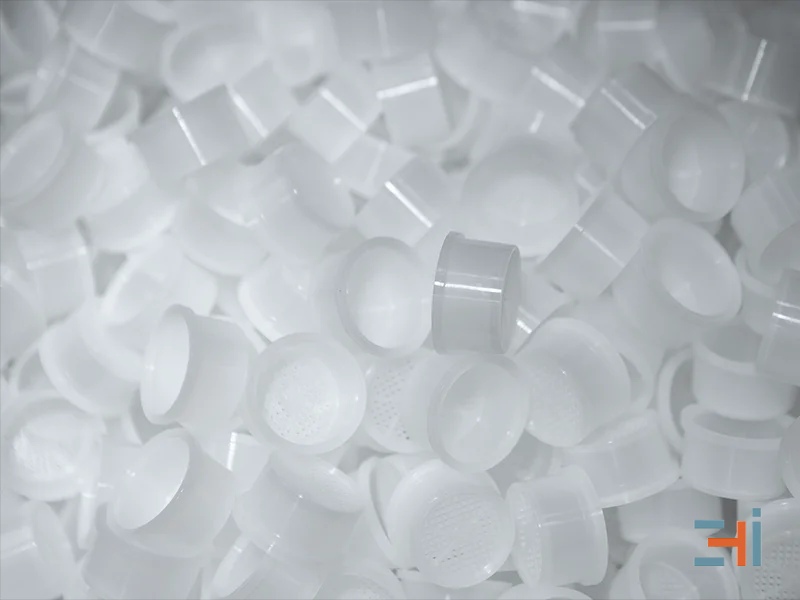
The quality of a plastic item largely depends on the initial selection of the raw material. At ETI Srl we use thermoplastic materials sourced from qualified suppliers, allowing us to manufacture functional and traceable components throughout the entire production chain.
We carry out contract moulding for a wide range of sectors and applications, using polymers such as PP and PE, selected for their resistance and processability. Each material is evaluated according to its suitability for the intended application; we take into account factors such as thermal behaviour, mechanical properties and aesthetic characteristics.
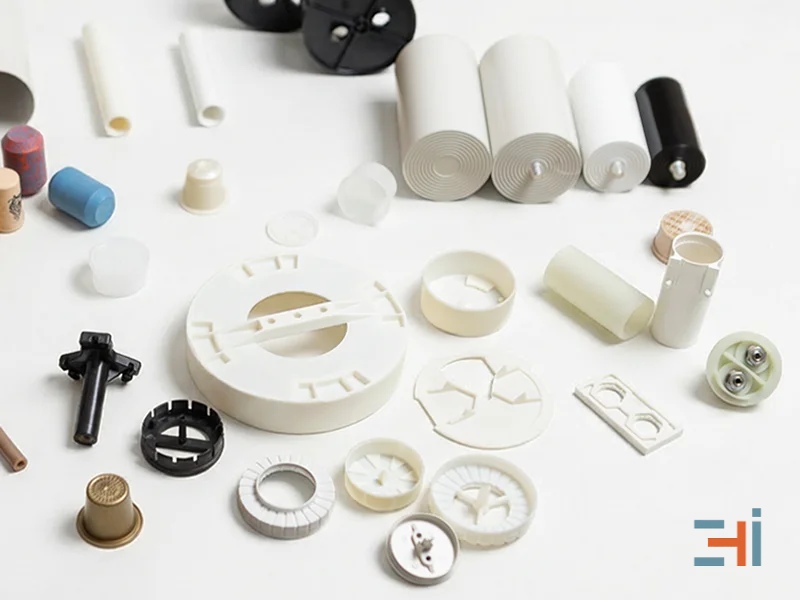
All our batches are supplied with detailed technical documentation, and every stage of the process undergoes internal checks to ensure repeatability and control. Whether producing caps, containers, capsules or technical components, we ensure that the properties of the plastic are preserved through to the finished part.
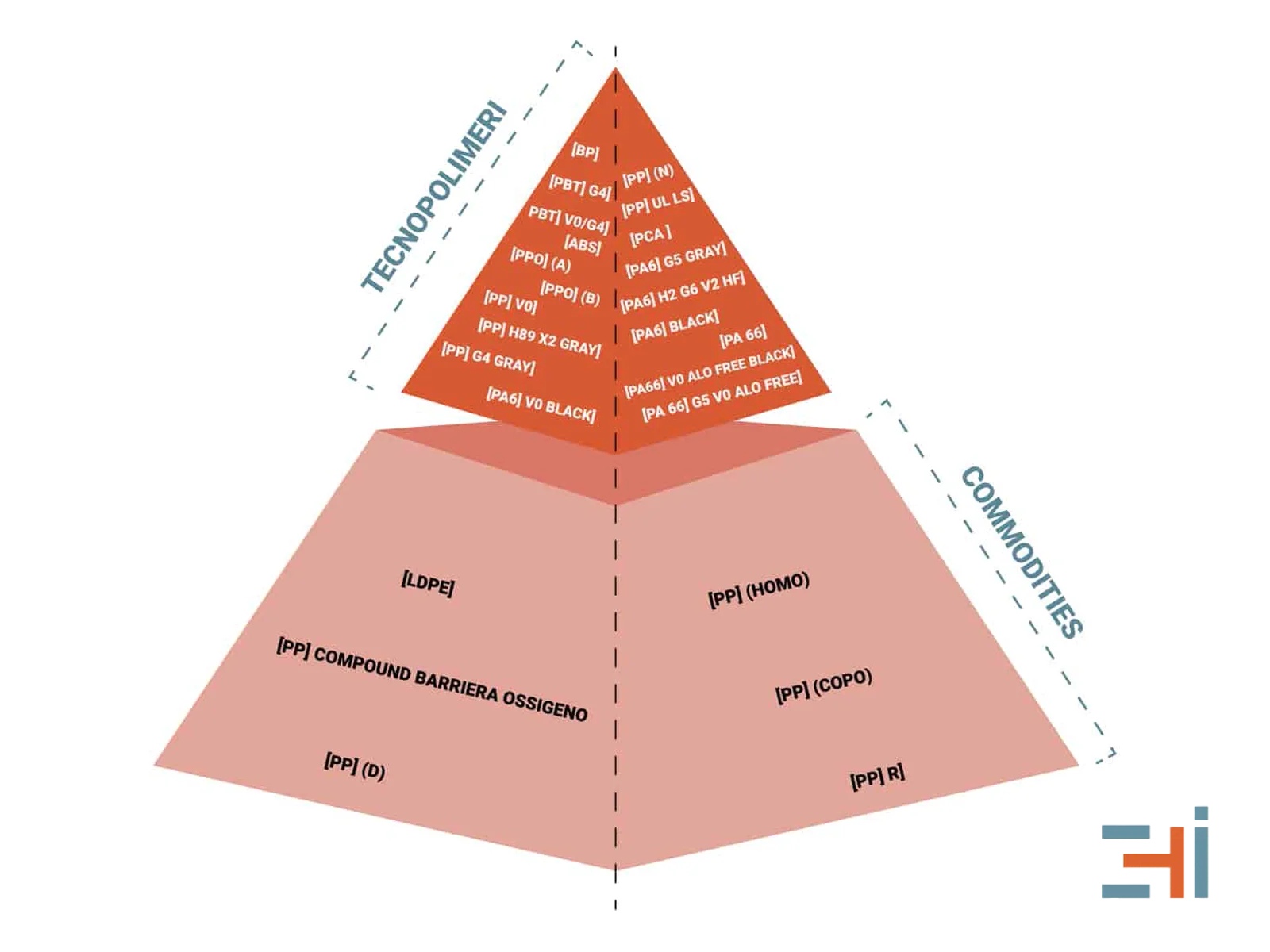
Engineering polymers
[BP]
Biopolymer – Compostable thermoplastic compound based on PLA
Application: Compostable capsules for coffee, infusions and soluble products
[PBT] G4]
ENGINEERING POLYMER filled with 20% natural glass fibre – HB (flammable). Characteristics: Non-hygroscopic, good dimensional stability. Available in HB or V-0 grades, without intermediate flame-retardant classifications.
Application: Electrical sector (specific internal parts for electrical capacitors, capacitor winding plugs where flame retardancy is not required, housings with V-0 flame retardancy)
[PBT] V0/G4]
PBT with 20% glass fibre.
UL 94 V-0 certified flame-retardant.
High resistance to flame propagation.
High density because, in addition to glass fibre, the halogenated flame-retardant package contains a mineral component (antimony trioxide).
[ABS]
Characteristics:
– Gloss finish
– Can be chrome-plated/painted
– Reinforced with glass fibre
– Does not offer high chemical resistance
– HB UL 94 flammability rating
– Highly flammable: V-0 grades are directly after HB grades Due to the high content of flame-retardant additives, the V-0 versions lead to reduced mechanical and aesthetic performance compared to standard ABS grades
Application: electrical sector
[PPO] (A)
UL 94 V-1 flame-retardant.
Contains high percentages of PS:
– BENEFITS: improved material processability
– DRAWBACKS: lower resistance to high temperatures, lower Vicat and HDT values, RTI not certified
EXCELLENT electrical resistance and dimensional stability
POOR chemical resistance
[PPO] (B)
(Sabic Noryl SE1 grey): low percentages of PS
– More complex material processing
– Higher heat resistance
– RTI certified 110°-105°-110°)
– Good heat dissipation
– Can be painted (rigid parts)
– Can be compounded with blowing agents to create a microcellular structure
– Halogen-free
– Not compatible with contact with hydrocarbons
Application: electrical sector; food-safe grades are also available.
[PP] V0]
UL 94 V-0 flame-retardant PP.
Application: electrical sector
[PP] H89 X2 Gray]
PP V-2 – UL V-2 certified – GWIT and GWFI
Application: electrical sector
[PP] G4 Grey]
Special ETI product.
20% glass fibre reinforced grey PP homopolymer with high melt flow rate.
Application: electrical sector
[PP] (N)
Polypropylene with high melt flow rate and medium stiffness
Suitable for low-temperature applications (< 0 °C)
Used for thin-wall applications < 1.3 mm
[PP] UL LS]
UL 94 V-2 flame-retardant PP that:
– Contains antimony trioxide
– Is UL certified for V-2 flame retardancy and RTI 105 °C
– Is not suitable for UV exposure
– Is laser-markable thanks to the addition of special powdered mica
Application: electrical sector
[PCA]
UL 94 V-0 flame-retardant.
– Blend of PC and ABS
– Wall thicknesses > 1.6 mm
– Used exclusively for the production of caps in the electrical sector
Increasing the percentage of PC results in a higher HDT > 140 °C.
ABS is added to improve processability (softer material).
Application: electrical sector.
[PA6] G5 GRAY]
PA6 polyamide with 25% glass fibre, Grey RAL 7033.
Also known as Nylon.
Depending on the polymer, it is divided into:
– Nylon 6,6 derived from hexamethylenediamine
– Nylon 6 obtained from caprolactam
PA6: softer, but with longer moulding cycles compared to PA66.
PA6 A G5 GR is used by ETI in the electrical capacitor sector.
[PAS] H2 G6 V2 HF]
H2 for high temperature resistance
HF Halogen-free and without red phosphorus
Application: parts for electrical capacitors.
[PA6] BLACK]
Application: housings for electrical capacitors.
[PA 66]
Colours:
– Natural
– Black
Application: plastic fasteners for the electrical sector
[PA 66] V0 ALO FREE BLACK]
Halogen-free and without red phosphorus, featuring GWIT 775° and CTI 600.
Application: moulding of plates for the electrical sector
[PA 66] G5 V0 ALO FREE]
[PA 66 G5 V0 Halo Free] = PA66 V-0 with 25% glass fibre, halogen-free and without red phosphorus, featuring GWIT 775° and CTI 600.
Application: electrical sector
[PA6] V0 BLACK]
– Unfilled
– Halogen-free
Application: electrical sector
Commodities
[LDPE]
Low-density polyethylene.
Grades used: MFI 3.5/10
Application: production of wine caps
[PP] OXYGEN BARRIER COMPOUND
Used in the packaging sector to achieve an excellent oxygen and vapour barrier, making the product highly competitive. Thanks to this polymer, external flow packs can be avoided.
Compounded PP: depending on the technical requirements of the finished product, talc, carbon or glass fibre fillers can be added.
[PP] (HOMO)
High-stiffness PP homopolymer (high elastic modulus).
Applications:
– Electrical sector
– Food sector
[PP] (D)
PP filled with 27% talc.
Features a high flexural modulus and high HDT.
Used in the electrical sector.
Good sliding surface properties.
Products manufactured with this material also offer greater resistance to adhesion compared to standard PP.
Application:
– Household appliances: detergent trays for washing machines and dishwashers
[PP] (COPO)
Medium melt flow rate polypropylene
Medium stiffness
Also suitable for use at low temperatures (down to -20 °C)
Used for products with wall thicknesses > 1.3 mm
[PP] R]
Polypropylene is divided into 3 groups:
– HOMOpolymer (PP H): symmetrically ordered molecular structure
– COpolymer (PP C): made up of alternating blocks of propylene and ethylene
– Random Copolymer (PP R): made up of random blocks of propylene and ethylene molecules
– All PP grades can be compounded at source with antistatic agents to reduce dust attraction and with nucleating agents to accelerate crystallisation during cooling
– In general, as the PP molecular chain becomes shorter, melt flow rate and brittleness increase proportionally
– The evolution of industrial processes over time has led to short-chain PP grades with melt flow rate twice as high as those available 20 years ago, while maintaining the elasticity and resilience of previous grades
– HOMOpolymers can achieve a higher flexural modulus than COpolymers Some special grades can also be reinforced with the addition of mineral fillers (10–15%), offer better resistance to elevated temperatures (HDT 10–12 °C higher than PP C), but are not recommended for applications below 0 °C.
RANDOM PP grades (PP R) offer HIGH TRANSPARENCY, are highly elastic and DO NOT STRESS-WHITEN ALONG BEND LINES, while resisting operating temperatures from 0 to 70 °C.
A technical guide to material selection
Every sector requires different properties. This is why we provide personalised consultancy to select the most suitable polymer. We consider factors such as mechanical resistance, transparency, elasticity, stiffness, thermal behaviour and compatibility with other elements, ensuring optimal performance in every application context.
- For projects in the electrical or technical-industrial sector, we recommend PA or ABS, which provide precision and stability even in complex environments.
- For food and cosmetic packaging, PP is particularly suitable thanks to its safety, processability and availability in multiple grades.
- When light weight and transparency are required, PS or PC are excellent solutions for both the functional and aesthetic aspects of the product.
We manage a constantly stocked warehouse, with selected suppliers and ready-to-use materials, ensuring flexibility, efficiency and fast response times even for large orders, prototypes or initial sampling runs.
Request a consultation with one of our experts to find the right material for your project.
Create your thermoplastic components with us
Contact us to place your order